Some features (saving, accounts, bookings) are temporarily unavailable. Calculators and content still work.
    Knowledge Hub

    Navigate working library

    Sales Plan Template

    Choose your sales focus, set realistic targets and turn them into work your team can deliver.

    Optional: sales targets companion (Excel)

    Free to use and share · No account required

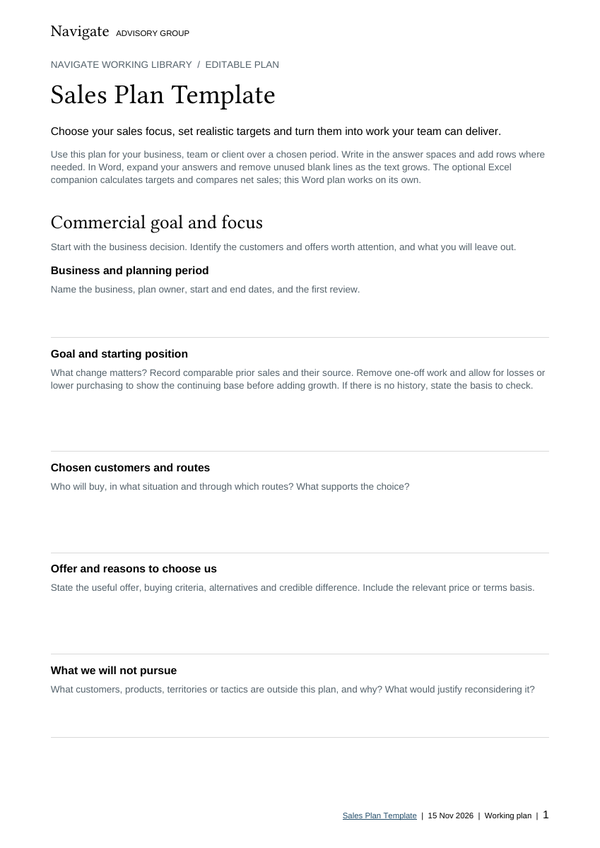
    First page of the blank editable Sales Plan Template

    Inside the plan

    Blank working plan. See the completed example below or take the editable file.

    Printable PDF

    Updated 15 November 2026

    When it helps: An owner, sales leader or adviser needs a practical period plan for their business or client, including the people and resources behind the targets.

    The working tool

    See it in use

    Fictional specialist garden parts supplier

    Northbank Garden Parts will protect useful repeat trade and test a limited local stockist route. Its AUD 64,000 net-sales target depends on the account, stock and dispatch assumptions below. Maya will review the first evidence on 18 November before extending the approach.

    01 / 05

    Commercial goal and focus

    Start with the business decision. Identify the customers and offers worth attention, and what you will leave out.

    Business and planning period

    Northbank Garden Parts. Owner: Maya Chen. Period: 4 November 2026 to 26 January 2027, 12 weeks. First review: 18 November. Maya and sales coordinator Owen review the account and order plan together.

    Goal and starting position

    Target AUD 64,000 net sales while keeping delivery commitments realistic. The fictional prior 12-week sales ledger totals AUD 60,000: AUD 56,000 standard repeat-range sales and AUD 4,000 one-off clearance that will not repeat. The account schedule indicates AUD 4,000 lost business and AUD 4,000 lower purchasing in the next period. Those reductions are included in the target, not ignored.

    Chosen customers and routes

    Serve existing landscape-maintenance accounts that need dependable replacement fittings and repair kits. Use agreed account contact and clear reorder information. Add four suitable independent garden shops in the current delivery area through a small stockist introduction. Existing account order history and local shop enquiries justify investigation; they do not prove the new-stockist target will be met.

    Offer and reasons to choose us

    A focused range of compatible replacement fittings, stock availability, a clear trade price list and dependable dispatch dates. Contractors can replenish familiar parts; shops can test a limited starter range with usable product information. Customers can use a national wholesaler or their current supplier. We compete on a relevant range and reliable information, not a claim to be cheapest. Prices follow the current net trade list.

    What we will not pursue

    No national chain tenders, new distant territories, broad discount campaign or unsupported next-day promise. The small team cannot support their volume, pricing and service demands this period. Reconsider a larger route only after stock, freight economics and account support are understood.

    02 / 05

    Targets and sales basis

    The AUD 64,000 target requires AUD 16,000 of additional sales, not just AUD 4,000 of growth.

    The target in context

    The work behind the AUD 64,000 target

    Fictional Northbank plan · Net sales excluding GST · 4 November to 26 January

    Existing accounts · Standard repeat range
    AUD 48,000
    Existing accounts · Additional range
    AUD 8,000
    New stockists · First orders
    AUD 6,000
    New stockists · Further period orders
    AUD 2,000

    AUD 64,000 target for the full period

    AUD 48,000 comes from the continuing standard range. The other AUD 16,000 must come from additional range and new stockists. These are planned sales, not confirmed demand or cash.

    Currency tax and timing

    AUD excluding GST. Count invoiced goods dispatched from 4 November to 26 January, net of discounts, returns and credit notes attributable to this period. Apply the same definition to targets and actuals. This is a sales-management basis, not an assumption that orders are immediately dispatched or paid.

    Sales targets

    Scroll tables sideways, or focus a table and use the arrow keys.

    Sales streamTarget methodNet sales targetEvidence and assumptions
    Existing accounts Standard repeat rangeDirect revenueAUD 48,000AUD 56,000 comparable standard-range sales less AUD 4,000 lost business and AUD 4,000 lower purchasing. Confirm account by account.
    Existing accounts Additional rangeDirect revenueAUD 8,000Incremental products for accounts active at the start. Excludes their standard-range sales above. Customer interest is not an accepted order.
    New stockists First orders4 orders at net AUD 1,500AUD 6,000Four suitable shops are the target, not contracted distribution. Use a limited starter range and check delivery dates.
    New stockists Further period ordersDirect revenueAUD 2,000Include their follow-on sales within these 12 weeks here, not in existing-account rows. Reorder timing remains uncertain.

    Total and what is already accepted

    AUD 64,000 target. AUD 18,000 accepted orders with confirmed dispatch dates are already part of the account schedule; do not add them again. AUD 46,000 remains uncommitted target. The target is not a probability-weighted forecast or a cash collection promise.

    Uncertainty and changes to test

    Maya verifies the AUD 8,000 loss/contraction allowance by 6 November. Owen checks whether the additional range solves a real replenishment need before proposing it. If stockists cannot sell the starter range or repeat within the period, reduce or move their target rather than relabel an order as revenue. Transfer the actual delivery and payment timing to the business budget and cash forecast.

    A defined-period target with a clear sales basis, non-overlapping streams and visible assumptions.

    03 / 05

    Routes and practical sales approach

    Choose how buying will work. Use a route that suits the customer rather than prescribing calls, a sales-rep funnel or every available channel.

    Chosen approaches

    1. Existing contractors Agreed account contact
      Offer and next buyer action
      Send a useful availability and price sheet through the agreed contact route. Ask the customer to confirm its actual replenishment need and timing.
      Who sells and supports
      Owen maintains the account list and follows up agreed next actions. Maya handles exceptions; warehouse lead Sam confirms stock.
      Limits and review
      No automatic bulk marketing sequence. Record reduced demand or a poor fit. Review the account schedule each fortnight.
    2. Existing accounts Relevant additional range
      Offer and next buyer action
      Show the fitting or kit only where it solves an identified need. Let the buyer compare its present alternative and request a suitable order.
      Who sells and supports
      Owen uses a simple compatibility and product-information sheet. Sam checks that the required items can be supplied.
      Limits and review
      No extra item merely to increase basket size. Keep incremental sales separate from the base and correct unsuitable recommendations.
    3. New local stockists Selected introductions
      Offer and next buyer action
      Discuss customer fit, current range and shelf capacity. Offer a limited paid starter order with agreed stock, price and product information.
      Who sells and supports
      Maya selects suitable shops and agrees the commercial arrangement. Owen supplies ordering information and follows the first order.
      Limits and review
      No assumed exclusivity, resale commitment or commission. Confirm who orders, pays, receives and supports customers before accepting work.

    Materials tools and responsibilities

    Use the existing account sheet and order system, not a new CRM project. The price sheet shows product fit, pack size, availability, freight basis and ordering contact. Owen records the customer's requested items, timing, agreed next action and owner. Sam accepts an order for scheduling only after stock and the dispatch promise are confirmed. Questions and lost-order reasons return to Maya's marketing and range review.

    04 / 05

    People capacity and resources

    Check both selling and fulfilment before making promises. Use the same period and units when comparing demand with capacity.

    People and support

    Across the 12 weeks, Maya reserves 72 hours for selected-account work and decisions; Owen reserves 96 hours for account contact, order support and records. These are available hours after leave and other duties, not total staff hours or salary estimates. Sam owns the warehouse schedule and product availability. Maya briefs Owen on the new range before customer contact.

    Fulfilment and stock limits

    The manual account/order schedule estimates 134 dispatches during the period against 160 workable dispatch slots after leave and normal duties, leaving 26 slots. The 45 dispatches already committed are included in the 134, not subtracted again. The revenue target alone does not establish this order count. Two fast-moving fittings have a three-week replenishment lead time. Sam checks the dated stock schedule weekly; an available dispatch slot does not mean every item is in stock.

    Pricing discounts and payment terms

    Owen uses the current net trade price list and cannot offer a discount or free freight. Maya considers exceptions only after checking product cost, freight and the customer's reason. Existing accounts retain their agreed terms. New starter orders are paid before dispatch unless Maya approves credit through the business's normal process. No open-ended supply or service commitment is included.

    Additional resources for this plan

    Scroll tables sideways, or focus a table and use the arrow keys.

    ResourceCash allowanceOwner and treatment
    Sample parts and selected stockist visitsAUD 1,200Maya. Incremental external spend, excluding GST.
    Price and product-information updateAUD 450Owen coordinates the external layout update.
    Selling and account support timeTracked separately168 team hours above. No invented hourly cost or salary included in the cash total.

    Budget connection and response to a shortfall

    The fictional owner allocates AUD 1,650 incremental cash in the business budget. Ordinary stock procurement, warehouse wages and freight remain in that budget; AUD 1,650 is not total selling or operating cost. It does not establish profit or ROI. If stock or fulfilment cannot support an order, agree a later date, narrower range or changed target before acceptance.

    05 / 05

    Actions customer value and review

    Leave with useful work someone will own. Review what happened and change the plan where the evidence calls for it.

    First actions

    Scroll tables sideways, or focus a table and use the arrow keys.

    Action and useful outputOwnerDueDependency and review
    Verify the base, losses, lower demand and additional-range assumptions in the dated account schedule.Maya6 NovUse the ledger and customer information. Revise targets if the allowance is wrong.
    Confirm stock, replenishment dates and dispatch slots before making promises.Sam6 NovInclude accepted orders once. Recheck stock weekly and flag an unfulfillable promise.
    Finish the price, fit and ordering sheet. Brief Owen on the range.Owen11 NovMaya confirms terms; Sam confirms stock. Use the AUD 450 layout allowance.
    Discuss fit with selected shops, record needs and agree any first order and follow-up.Maya18 NovUse the sample/visit allowance. Review learning before committing the full stockist target.

    First value repeat business and concerns

    Owen checks the first stockist delivery arrived as agreed and that the shop can identify and order the parts correctly. Record any incorrect fit, shortage or unclear information and assign its correction. Agree whether and when a replenishment conversation is useful. Do not sell additional stock to hide poor sell-through or an unresolved issue.

    Measures and decisions

    Measure and targetSource and ownerReview and response
    Net period sales AUD 64,000Invoice/dispatch ledger, net of credits and returns. Owen.Fortnightly from 18 Nov. Compare dated actuals with the order schedule, not the whole-period target alone.
    Existing standard-range sales AUD 48,000Existing-at-start account schedule and the same ledger. Maya.Inspect customer reasons for loss/contraction. Change the offer, service or target where justified.
    Dispatch promises at risk Resolve before commitmentDated stock and dispatch schedule. Sam.Weekly. Agree a revised date or range before an unsupported order. Feed recurring issues into the operating plan.

    Review record

    Forward plan as at 4 November; no results claimed. On 18 November, Maya records dated actuals, the order schedule and stockist learning, decides what to keep, change or stop, and sets the next owner and review.

    Owned next actions and a review that changes the plan when needed.

    Choose a few workable routes, allow for lost or reduced business, and confirm the resources behind your targets. A target states what you intend to achieve; accepted orders, a forecast and cash receipts are different records.

    This is a fictional teaching example, not a client result.

    Start with a decision rather than a quota

    A sales plan decides where the business will put its attention and what it can responsibly promise over a defined period. It joins the customer, offer, route to purchase, sales target and practical work. A list of calls or a revenue number alone does not make that connection.

    Use the plan for an existing business, a team or a client. Start with the period and the decision: protect a useful customer base, introduce a suitable offer, enter a limited route or correct an approach that is not working. Bring the comparable sales record, current orders, customer feedback and delivery constraints you already have. Record missing evidence as a question with an owner, rather than fill the gap with a confident estimate.

    This is a period-wide plan. Use the separate B2B Sales Playbook when a particular complex opportunity needs discovery, stakeholder, proposal or negotiation work. A retailer may work with categories and repeat purchases rather than named opportunities; a service business may work with bookings and available job hours.

    Choose the work worth winning

    Choose the customers, buying needs and offers that deserve attention this period. Explain why the route fits, what the customer can use instead, and what you will leave out. Good focus is a trade-off supported by customer need and the ability to serve it; it is not merely the largest market or the easiest channel to name.

    In the illustration, Northbank protects relevant repeat trade and tests a few local stockists. Existing account information and shop enquiries justify investigation, but do not prove the target. The choice also excludes national chain tenders, distant territories and unsupported dispatch promises. Those exclusions make the proposed use of a small team more credible.

    For your plan, distinguish an observation from its interpretation. A customer saying that a product is interesting is evidence of interest, not an order. Ask what they use now, when they need a replacement, who decides and what prevents a purchase. Explain which observation supports your choice and which next fact could make you change it.

    Build a target you can explain

    Use comparable sales as a starting point, not as an entitlement to repeat revenue. Remove one-off business and allow for known loss or reduced demand. Add distinct incremental and new-customer streams so each sale appears once. Use direct net revenue or meaningful quantities multiplied by net value; do not add a speculative funnel simply to produce a convincing total.

    Northbank starts with AUD 60,000 in the prior period. Removing AUD 4,000 one-off clearance, AUD 4,000 lost business and AUD 4,000 lower purchasing leaves an AUD 48,000 continuing base. Its AUD 64,000 target therefore needs AUD 16,000 of additional-range and new-stockist work, not merely AUD 4,000 more sales. The target table shows the four non-overlapping streams and their assumptions.

    Define the period, currency, tax and sales basis before adding the numbers. Keep accepted orders inside the target where they belong. Northbank’s AUD 18,000 accepted orders are not another stream to add to AUD 64,000; they leave AUD 46,000 of uncommitted target. An accepted order, a dispatched or invoiced sale, a probability-weighted forecast and a cash receipt answer different questions.

    Design the buying and delivery route

    Describe what the buyer needs to do next and what makes that action useful and possible. Then name the information, response owner and handoff behind it. A route is more than a communication channel: the buyer must be able to understand fit and terms, ask a question, agree the purchase and receive the promised result.

    Northbank’s existing contractors get relevant availability and reorder information through agreed account contact. Its selected shops need a discussion about fit, range and shelf capacity before a limited starter order. Those routes require different preparation. Neither calls for an automatic bulk sequence or an assumed distribution agreement.

    Use a route your customer will recognise. State who confirms price, product fit, stock, service scope and delivery timing before acceptance. Include the first useful result after purchase and how a problem will be corrected. A repeat-purchase target is weak if the first delivery is wrong or the buyer cannot use what arrived.

    Check what must be true before promising

    Connect the approach to available selling and support time, dated stock and delivery capacity, existing commitments, and authority over price and terms. Compare matching periods and units. Revenue alone does not establish dispatch volume, service hours or staffing needs.

    Northbank’s separate schedule estimates 134 dispatches against 160 workable slots; its 45 committed dispatches are already within the 134. Subtracting them again would understate capacity. The remaining slots still do not prove the necessary products are in stock: two fittings have a three-week replenishment lead time. A practical plan checks both constraints.

    Keep incremental external spending separate from team time and the wider operating budget. Northbank’s AUD 1,650 allowance is not its total operating cost and does not establish profit or ROI. Use the business budget for costs and the cash forecast for when money is paid or received. Where the plan does not fit, change the date, range, route or target before making a commitment.

    Use the review to make a different decision

    A review needs dated evidence and an action, not another report of activity. Compare actual sales with the relevant schedule and assumptions, inspect customer reasons and delivery issues, then decide what to keep, change or stop. Give the decision an owner and next check. A whole-period remaining target does not by itself show whether you are ahead or behind today.

    For a hypothetical timing change—not a result in the example—suppose one planned starter order moves beyond the period. The first-order stream would lose AUD 1,500 if everything else stayed the same. But the AUD 2,000 further-order stream may also depend on that starter timing. Recheck both rather than mechanically announce a revised total. Update the dated order assumptions, delivery work and cash timing together.

    Retain the earlier plan and record the evidence cutoff, decision and new assumptions. The workbook can help compare matching-basis targets and actuals; it does not decide which route is worthwhile or calculate profit, marketing attribution or cash flow. The useful result is a changed plan that the responsible people can act on.

    Take the work further if useful

    Use the tool yourself, prepare business-specific work, or involve an expert for feedback, revision, implementation or ongoing support. Choose what the situation needs.

    The work brief keeps this resource reference. Add your completed file or notes there; downloaded worksheets are not read or imported automatically.

    Sales planning is an established business practice. These working tools, explanations and fictional illustration are original Navigate material, informed by practical sales planning guidance from BDC and HubSpot with Aircall.

    Further reading