Some features (saving, accounts, bookings) are temporarily unavailable. Calculators and content still work.
    Knowledge Hub

    Navigate working library

    Marketing Plan Template

    Choose a customer focus and a credible promise, then decide how to reach people, fund the work and learn what to change.

    Optional: marketing spending and effort workbook (Excel)

    Free to use and share · No account required

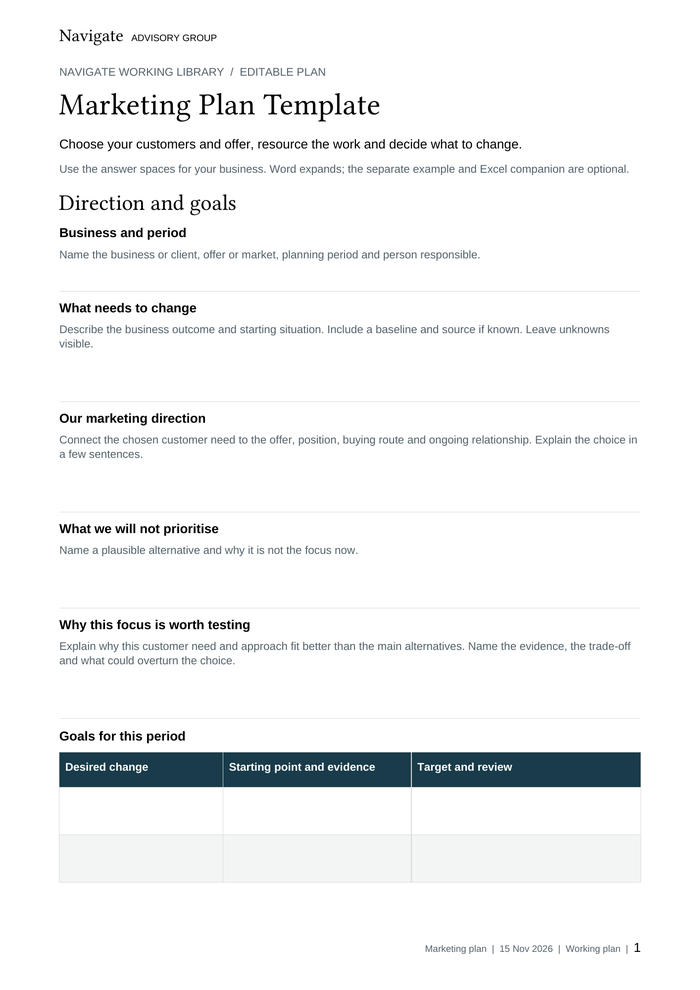
    First page of the blank editable Marketing Plan Template

    Inside the plan

    Blank working plan. See the completed example below or take the editable file.

    Printable PDF

    Updated 15 November 2026

    When it helps: An owner, team or adviser needs an overall marketing direction and a feasible programme for a business, offer or market. Useful for new plans and reviews of existing activity.

    The working tool

    See it in use

    Fictional local plant nursery

    Fern Street Nursery is testing a local small-space gardening offer without stretching its shop team. Follow the initial choice, then see how hypothetical new customer evidence changes the offer, message, programme and measures before further promotion.

    01 / 07

    Direction and goals

    Fern Street Nursery. Plan for container plants and care support, 4 November to 18 December 2026. Maya owns the plan; Ellis coordinates shop activities.

    The working choice

    Shop questions suggest that nearby balcony and patio gardeners need help choosing suitable plants; the evidence is weak. Make the nursery easier to choose for them. Begin with a clearly priced starter set, individual items where a set is unsuitable, and practical care support. Use the existing website for information and stock enquiries, with buying and collection at the shop. A small clinic makes the advice tangible. Defer bulk landscaping, a full delivery launch and broad discounting: these require different stock, economics or fulfilment and do not necessarily resolve uncertainty about suitability. A broader catalogue would not necessarily solve that uncertainty. Keep general shop customers welcome. There is no reliable segment or repeat-purchase baseline. Maya first checks recent buying experiences, stock and contribution; if people prefer advice and individual choice, change the offer before promotion.

    Goals for this period

    Scroll tables sideways, or focus a table and use the arrow keys.

    Desired changeStarting point and evidenceTarget and review
    Suitable starter-set purchases.No tagged baseline. Begin a till tag when the offer is ready.Working target: 24 sets from 16 Nov to 18 Dec. A chosen target, not a forecast. Ellis checks weekly.
    Useful care support.No consistent log. Begin a record of voluntary care questions.Review 10 care conversations by 18 Dec. Maya identifies recurring issues and useful changes. Repeat-sales uplift remains unknown.

    Choose a useful direction and working goals; make the assumptions that could change the choice visible.

    02 / 07

    Customer evidence and alternatives

    Ask about a recent purchase before presenting your offer. What was the person trying to do? What did they consider and choose? What nearly stopped them? What did they already have? What help did they need afterwards? Record what happened separately from your interpretation, then note what would change your decision.

    Evidence that informs the choice

    Scroll tables sideways, or focus a table and use the arrow keys.

    Observation and sourceWhat it may meanUnknown and next check
    Illustrative shop notes, 1–3 Nov: several customers asked which plants would suit a sunny balcony.Suitability advice could be more valuable than simply showing more plants.This small convenience sample does not establish demand. Maya asks six recent or potential customers about their last plant purchase by 10 Nov.
    Illustrative till review, 3 Nov: plant sales are recorded, but starter sets and returning customers are not identifiable.Total sales alone cannot evaluate this plan.Ellis agrees a simple till tag and a voluntary care-question log before promotion.
    Illustrative stock check, 4 Nov: the proposed plants are available now; later replenishment is not confirmed.The offer must fit stock and supplier lead times.Maya confirms quantities and substitutions before promising availability. No summer demand or supplier guarantee is inferred.

    Buying situation and criteria

    The gardener usually chooses and pays, sometimes with a household member. They may have limited room, uncertain light conditions or a past plant failure. Useful advice, visible plant condition, manageable care and a clear total price may matter. Interviews should test these assumptions, including with people who left without buying.

    What customers could choose instead

    Customer alternativeWhy it may be chosenOur response or next check
    Large hardware or garden retailerConvenient location, a broad range or a lower displayed price.Do not claim to be cheaper. Show what the set includes and offer relevant advice; check the actual alternatives customers mention.
    Buy separate plants onlineConvenient browsing and delivery; suitability may still be uncertain.Show real set contents and care information online. Keep delivery outside this plan until fulfilment is ready.
    Use existing plants or postponeAvoids cost or another failed purchase.Let customers bring a photo and discuss light and care first. A sensible recommendation may be to buy nothing yet.

    The shop questions justify a focused check, not a demand estimate. A recommendation to buy nothing yet can be the right result.

    03 / 07

    Offer and customer experience

    Check the message against the plan: who it is for, what the customer receives, why the promise is credible and what they should do next. If the route, stock or service cannot support the message, change the promise before promoting it.

    Priority customers and position

    Prioritise nearby balcony and patio gardeners who want practical help choosing and caring for container plants. Position the nursery as a local place to make a suitable choice with advice after purchase. Support that promise with labelled options, staff guidance, clear care instructions and honest limits. Customer interviews may change the segment or offer.

    Offering and customer value

    Proposed sunny balcony set: one rosemary plant, a matching pot and saucer, potting mix and a care sheet. Staff check light, space and care time before recommending. Confirm suitability and item costs first; offer individual items when the set is not useful.

    Price and terms

    Test a displayed AUD 65 starter set including GST. Maya checks item costs, contribution and the value of included advice before finalising. This illustrative price is not validated willingness to pay. No blanket discount or credit offer.

    Buying and delivery routes

    Buy and collect at the shop. The website explains suitability, contents, price and how to ask about stock; it is not a new online checkout. Staff confirm stock before reserving a set. No delivery promise in this period.

    Brand message and support

    Message: choose plants that fit your small space, with help caring for them. Show actual set contents, readable plant labels and a short staff demonstration. Avoid promises that every plant will thrive or that sets save money without a real comparison.

    Customer relationships and repeat business

    Give every buyer the care sheet and explain how to ask a question. Offer optional care reminders only with permission. Log recurring issues and improve advice. Invite satisfied customers to tell a friend; do not assume a purchase means email consent or require a referral.

    People and service process

    Ellis briefs two shop colleagues and checks labels daily. Maya confirms suppliers and handles uncertain suitability questions. Cap each clinic at six people so normal shop advice remains available. Pause invitations if stock or shop cover cannot support them.

    Draft customer message

    Plants for your balcony, chosen with you Unsure what will suit your space? Bring a photo and tell us about the light and the time you have for care. Our sunny-balcony starter set includes a rosemary plant, matching pot and saucer, potting mix and a care sheet for AUD 65 including GST. Individual items are also available. Ask us about suitability and current stock before reserving. If the set is not right for you, we will explain other options.

    The offer, total price, buying route, promise and support must describe the same experience.

    04 / 07

    Marketing programme

    The website, shop, clinic and care support have different jobs in one plan. Amounts below are planned AUD external spending excluding GST; team hours are separate.

    Why these activities work together

    The website helps a person check contents and suitability before a visit; clear shop information helps them choose; the clinic makes advice tangible; optional care follow-up supports successful use and future contact. A local listing and limited promotion point to the same offer. Broad paid reach is deferred until that offer is clearer. Delivery advertising would promise a route the shop has not prepared. These choices are a test of fit, not a claim that local channels always outperform digital advertising.

    Actions and dependencies

    Scroll tables sideways, or focus a table and use the arrow keys.

    Action and customer responseOwner and timingCash and team effortMeasure and dependency
    Check needs and prepare the offer. Ask about the last plant purchase, compare alternatives and assemble a suitable small range.Maya. 5–13 NovAUD 120; 8 hoursSix conversations and a recorded offer decision, not six confirmations. Confirm stock and costs first.
    Make the choice clear in the shop and online. Show contents, suitability, total price and how to enquire about stock.Ellis. 10–20 NovAUD 280; 10 hoursCheck that a visitor can explain the offer and next step. Publish only after the customer and offer check resolves unsuitable options.
    Invite local gardeners to a small potting clinic through shop notices, one local listing and a limited local promotion.Ellis. 21 Nov–12 DecAUD 300; 12 hoursTrack enquiries, attendance and tagged set sales separately. Confirm stock and six-person session capacity before inviting.
    Provide care support and learn from buyers. Offer voluntary reminders and record useful questions and known return visits.Maya. 16 Nov–18 DecAUD 0; 6 hoursReview at least 10 voluntary care conversations. Keep permission and customer issues clear; do not count reminders as sales.

    First decision before committing

    Maya confirms the customer findings, set contents, contribution and stock before Ellis finishes the materials and invites people. If the set is not useful, change the offer first.

    The programme stays understandable without Excel. Change or defer an action when its dependency is not resolved.

    05 / 07

    Resources and trade-offs

    A spending limit shows what is available, not whether the programme is worth doing. Check contribution after product and direct service costs before treating more sales as a better result. Keep stock purchases, wages and cash timing in the wider business budget; this companion tracks external marketing spending and team hours, not return on investment.

    Spending and financial basis

    4 Nov–18 Dec 2026. AUD excluding GST for external marketing costs: M1 120, M2 280, M3 300, M4 0. Planned total 700 against a 900 cash-spend limit, leaving 200 unallocated. Staff wages and stock purchases are outside this marketing-spend register and must still be covered in the business budget.

    People and available time

    Maya and Ellis can commit 40 combined hours over the period with normal shop cover. The four actions use 36 hours; keep four hours unallocated for changes and customer questions. Do not add the delivery launch or another clinic without changing cover, scope or timing.

    Materials and approvals

    Maya approves the set contents and price after the cost and stock check. Ellis needs current photos, accurate labels, a booking limit and a clear way to record voluntary reminder permission. The website must match what the shop can supply.

    What could change the plan

    Scroll tables sideways, or focus a table and use the arrow keys.

    What could change the planResponse and owner
    Customers value individual advice but not the proposed set.Maya changes the assortment or sells items individually. Do not spend the remaining promotional budget just to defend the original idea.
    Plant availability, suitability or shop cover is inadequate.Ellis narrows the promoted range or postpones a clinic. Maya approves any extra spending or staff time before commitments increase.

    The resource decision

    The programme proposes AUD 700 of external spending and 36 team hours within the declared AUD 900 and 40-hour limits. The remainder is unallocated, not an automatic extension. Maya checks the costs, stock and shop cover before further commitments; review on 20 Nov.

    Unallocated money and time are not profit, realised savings or guaranteed extra capacity.

    06 / 07

    Review and next choices

    Decide what the evidence would mean before the next commitment. Keep the definitions and cutoff consistent; a sales change alone does not establish marketing causality.

    Measures and decisions

    Scroll tables sideways, or focus a table and use the arrow keys.

    Measure and definitionSource and timingActual and decision
    Tagged starter sets sold. Working target 24 from 16 Nov–18 Dec; not total nursery sales.Till tag checked weekly by Ellis. No comparable tagged baseline exists.Not yet measured. Review on 20 Nov and 18 Dec. Compare progress with stock, customer feedback and staff effort; sales alone do not establish marketing causality.
    Useful care conversations. Review at least 10 voluntary conversations by 18 Dec; log questions and changes needed.Short shop log, reviewed by Maya weekly. Note known returning buyers separately.Not yet measured. Improve advice if the same care problem repeats. Do not convert unknown repeat-purchase behaviour into an uplift claim.
    External marketing spending and team hours for the agreed period.Invoices or receipts and a simple time record. Review before each further commitment.Not yet measured. Compare with 700 planned spend and 36 planned hours, and the 900 and 40 limits. Change the plan before using unallocated resources.

    Next review and possible change

    Maya and Ellis review on 20 Nov before clinic promotion. If interviews do not support the starter set, revise the offer and message first. If stock or cover is inadequate, narrow the range or postpone invitations. Review the full period on 18 Dec before committing to further promotion.

    What we learned and will do next

    To complete after the review. Record what customers actually said, what sold, the support required and the resource use. A channel with few directly tracked sales may still support discovery or trust; investigate before assigning all credit or stopping it.

    A review should lead to a useful choice, not simply report activity or claim credit for every sale.

    07 / 07

    Revise the plan

    Hypothetical 20 November review within this fictional case. The observations and decisions below are invented to demonstrate revision; they are not reported business results. External spending below is AUD excluding GST; team hours are separate.

    The new evidence

    Suppose six short conversations about recent plant purchases produce four people who already have pots and want help choosing individual plants, and two gift buyers who prefer a complete set. This is a small convenience sample, not a population estimate. It weakens the assumption that a fixed set should lead all promotion, while preserving a possible gift-buying use.

    Keep the focus and change the lead offer

    Keep the local small-space focus and practical care support. What changes is the assumption that a fixed set should lead the offer. Lead with individually priced plants and suitability advice, retain the complete set as an option, and narrow the materials and clinic. This changes what the business will do, not only what the review says. Delivery stays outside the plan; the interviews do not prove demand. Maya makes this illustrative revision before further promotion.

    How the planned work and resources change

    Scroll tables sideways, or focus a table and use the arrow keys.

    Action and changeOriginal planRevised plan
    Customer and offer check Retain the completed research/decision allowance; do not count planned amounts as actual spending.AUD 120 8 hoursAUD 120 8 hours
    Shop and website information Replace the bundle-led display with individually labelled options and a short suitability guide. Narrow the production scope.AUD 280 10 hoursAUD 220 8 hours
    Local advice clinic Promote one small advice session rather than the bundle-led potting demonstration. Cap attendance at six; confirm shop cover and stock.AUD 300 12 hoursAUD 180 8 hours
    Care support Keep voluntary care follow-up and the question log.AUD 0 6 hoursAUD 0 6 hours
    Whole programmeAUD 700 36 hoursAUD 520 30 hours

    What the resource change means

    Revised external spending is AUD 520 excluding GST: 120 + 220 + 180 + 0. Team effort is 30 hours: 8 + 8 + 8 + 6. Against the unchanged AUD 900 and 40-hour limits, 380 and 10 hours remain unallocated. The reductions of 180 and 6 hours are changes to the plan, not realised savings or profit.

    The revised customer message

    Bring your balcony questions Already have a pot? Bring a photo of your space and tell us about the light. We can help you choose individually priced plants and explain their care. Ask about current stock and the next small advice session. Prefer a complete gift set? Ask us about the starter-set option.

    Use the new measure on its own terms

    Replace the 24-set working target with a new chosen target of 12 advice-assisted plant purchases from 21 November to 18 December. Tag these purchases separately and record whether the buyer chose individual items or a set. The counts have different definitions and must not be presented as a comparable sales trend. Keep the ten-care-conversation learning goal. Results, actual spending and actual hours remain unknown.

    Next action and review

    Ellis updates the materials and tracking before the next invitation. Maya checks the revised offer, contribution, stock and cover before release, then reviews customer questions and resource use on 4 December and the whole period on 18 December. If advice takes too much staff time, change the session scope or timing before adding promotion.

    Try the revision in Excel

    Try the revision in a separate copy of Nursery example. Keep row 18 at 120 and 8. Change C19/F19 to 220/8 and C20/F20 to 180/8; row 21 stays 0/6. Rename the changed activities. Totals become 520 and 30. Leave actuals and their date blank until known. The supplied workbook retains the original plan.

    For a B2B service, the user, sponsor and buyer may be different people. Adapt the segment and buying criteria, clarify the promised work and route to a conversation, and plan service capacity and ongoing contact. The same choices apply without a plant set, shop or clinic.

    The revised plan is AUD 520 and 30 hours. The changed offer, message, actions and definitions—not lower numbers alone—are the lesson.

    Choose the customer and useful promise first. Make the offering, price, buying route and customer experience support that choice, then fund a small coherent programme and review what would change it.

    This is a fictional teaching example, not a client result.

    Choose a focus worth acting on

    A useful focus combines a problem worth solving, people you can reach, an offer you can deliver and economics you can check. Compare it with the next-best use of the same money and time. Where a critical assumption is unknown, choose a small check and say what evidence would change the choice.

    Use customer conversations, sales and service records, current alternatives and appropriate research. The choice should explain the need, useful difference and credible support. A detailed persona or crowded SWOT is not a prerequisite. The nursery example considers broader range, discounting and delivery, but chooses a local suitability problem that its shop can investigate and serve.

    Learn from a recent buying decision

    Separate observation, interpretation and the next check. Broad market sources can inform size and trends; direct conversations can explain what happened in a particular buying situation. Do not use a small convenience sample as a demand estimate.

    Ask about a recent purchase before presenting your offer. What was the person trying to do? What did they consider and choose? What nearly stopped them? What did they already have? What help did they need afterwards? Record what happened separately from your interpretation, then note what would change your decision.

    Make the promise and experience agree

    Check the message against the plan: who it is for, what the customer receives, why the promise is credible and what they should do next. If the route, stock or service cannot support the message, change the promise before promoting it.

    Join the product or service, price and terms, buying and delivery route, actual customer message and support after purchase. A promotional medium is not a buying route. For services, include the people, process and evidence customers use to judge quality before they buy. The example supplies real draft copy, then rewrites it when the offer changes.

    Give each activity a useful job

    Start with the customer question or action each activity should support. A website may help someone assess suitability; a shop conversation may resolve a choice; a clinic may demonstrate use; care support can improve the experience after purchase. Choose the combination that fits the customer, economics and capacity—not every available channel.

    Compare a plausible alternative, name the dependency and define what you will observe. Enquiries, attendance, purchases and care conversations are different records. Limited direct attribution does not prove that an activity has no useful role.

    Fund work you can deliver

    A spending limit shows what is available, not whether the programme is worth doing. Check contribution after product and direct service costs before treating more sales as a better result. Keep stock purchases, wages and cash timing in the wider business budget; this companion tracks external marketing spending and team hours, not return on investment.

    Give actions an owner, timing, external cost, team effort and useful measure. Check stock, skills, shop or service cover and existing commitments before creating demand. Compare with declared limits; if the programme does not fit, change its scope, timing or route before adding commitments.

    Use learning to change the work

    Keep the earlier edition so the decision is visible. Connect new evidence to the assumption it changes, then update the affected offer, customer message, actions, resources and measures. A different plan is not a realised saving or a business result.

    The nursery revision preserves the local focus but changes the lead offer, actual message, materials, clinic and purchase definition. Its planned spending changes from 700 to 520 and time from 36 to 30 hours; actuals remain unknown. The 24-set and 12-advice-assisted-purchase targets use different definitions and periods, so they are not a comparable performance trend.

    Take the work further if useful

    Use the tool yourself, prepare business-specific work, or involve an expert for feedback, revision, implementation or ongoing support. Choose what the situation needs.

    The work brief keeps this resource reference. Add your completed file or notes there; downloaded worksheets are not read or imported automatically.

    Marketing planning draws on established customer research, segmentation, targeting, positioning and marketing mix practices. Original Navigate wording, layouts and fictional illustration. Reference guidance: business.gov.au Develop your marketing plan and The 5 Ps of marketing. A campaign, persona, SWOT or channel test can support the plan; none alone is the whole plan.

    Further reading