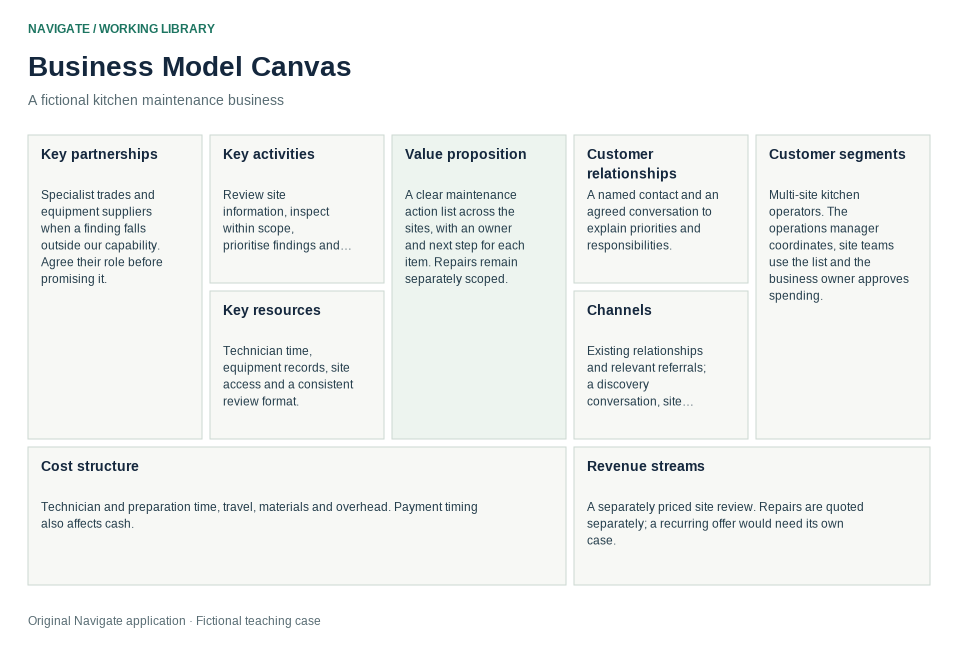
A business model shows how the business creates value, delivers it and earns enough to continue. The Business Model Canvas puts those connections in one view. It is useful when an offer is changing, margins disappoint or different people have different ideas about how the business works.
Start with one customer group and one offer. Use the worked map above to see the connections, then download a blank version for your own business or a client conversation.
Start with the customer’s situation
A maintenance firm says, “We keep commercial kitchens running.” A single-site café may need a fault fixed quickly. An operations manager responsible for several kitchens may need a clearer view of priorities and responsibilities. Those are related customers, but they may need different offers.
In the fictional example, an operator asks who will act on the items in a maintenance report. That changes the question from “Could we sell a subscription?” to “Would a defined review and action list help this person coordinate their sites?”
A weak entry: “All small businesses. Great service.”
A useful entry: “Operations managers coordinating several commercial kitchens, with the business owner approving the spend.”
The second version helps you decide whom to speak to, what to investigate and what work you would need to deliver.
Follow the connections
The nine parts describe a system, not nine independent answers. Read the map from customer to offer, then across delivery, relationships and money.
Scroll the table to see all columns.
| A change in the offer | What else must change? |
|---|---|
| An action list replaces a general findings report | The review needs enough information to identify priorities and the next responsible person. |
| Repairs are quoted separately | The sales conversation and written scope must make that clear before acceptance. |
| Several sites use the work | Site access, records and coordination affect the timetable and cost. |
| A specialist may be needed | Agree their contribution and responsibility before including it in the promise. |
The firm's revised proposal is a defined site review, with an action list and a discussion of priorities. That changes its activities and resources as well as its revenue. A separately priced review is easier to describe than an assumed all-inclusive subscription; whether customers will buy it remains a question to investigate.
Check whether the model can support the promise
A good customer proposition can still be expensive to deliver. Include preparation, review, travel and follow-through—not only the time spent with the customer. Consider standing costs and when cash moves.
The growth guide takes this fictional offer through its choices and economics. In that example, fewer purchases or longer delivery substantially reduce the amount left after setup. The canvas helps locate the connections; the calculation tests their implications.
Ask what happens if demand doubles, a key person is absent or customers pay later. If the business cannot support the promise, change the work, price, customer or delivery arrangement rather than only improving the pitch.
Find the assumption worth testing next
Read the fictional map as a connected decision
The proposed review is an action list people can use, with an owner and next step for each item. It is not a promise to repair everything for a recurring fee. Follow three connections through the map:
- Customer to useful output. The operations manager coordinates, site teams use the list and the owner approves spending. The action list and the conversation explaining responsibility are part of the offer, not merely how the findings are packaged.
- Promise to delivery. Useful priorities need records, site access, preparation and appropriate technician capability. Agree specialist contributions before promising them. Repairs remain separately scoped.
- Delivery to money. Preparation, travel, technician time and follow-through all consume resources. A separately priced review makes the paid work clearer, but the canvas does not establish a viable price, an order or enough demand.
Mark what comes from observation and what is still an assumption. Then choose the uncertainty that most affects the decision.
- Buying: who approves a purchase, and what did they buy the last time this problem occurred?
- Usefulness: can the customer use the proposed output to take the next action?
- Delivery: can the team produce it within the effort and capability available?
For this fictional firm, the next useful step is to put an example action list in front of the operations manager and ask them to use it to identify who acts next. Watch what is still unclear. Separately record the effort required to prepare and explain the output. Use those observations to revise the proposition, delivery assumptions and costs before deciding whether to broaden the offer. A positive conversation and a delivery-cost observation answer different questions; neither establishes the entire model.
Use the canvas as working material
Complete a first version in short statements. Leave a question where information is missing. Date it, identify the decision it supports and keep the earlier version when something changes.
Use the blank canvas independently, with colleagues or in a client workshop. The filled example shows how much specificity helps; it is not an answer to copy into an unrelated business. Use customer value to investigate one customer’s needs, or the Strategy decision outline when the main job is choosing between alternatives.
Method credit
The Business Model Canvas was developed by Alexander Osterwalder and Yves Pigneur and popularised through Strategyzer. Explore the original method. Navigate’s wording, layout and fictional example are original teaching material, not an official Strategyzer product. The canvas describes a model; it does not validate its assumptions.